
Imagine opening a quote for your dream workshop and seeing a number thousands over budget.
It is a terrible feeling.
Steel prices fluctuate, and hidden fees can sneak up on you. But here is the secret: you don’t have to sacrifice quality to save money. I have seen smart buyers save a fortune just by knowing how to buy.
In this guide, you will learn:
- What drives steel prices up or down.
- Design tricks that keep cash in your pocket.
- How to spot hidden fees.
- The best time to buy.
With the right plan, you can build exactly what you need without breaking the bank.
Understand What Actually Drives Steel Building Costs
Before you try to cut costs, you need to know where the money actually goes. Most people think the price is just about the size of the building. In reality, several other factors can double or triple your final bill.
Here is what really moves the needle on price:
- Steel Prices Fluctuate: Steel is a global commodity. Its price changes based on supply, demand, and even the cost of scrap metal. If you get a quote today, it might only be good for 7 to 14 days.
- The “Design Complexity” Factor: A simple rectangular box is the cheapest shape to build. Every time you add a hip roof, a dormer, or a valley gutter, the price jumps. Complex designs require more engineering and more labor to assemble.
- Wind and Snow Loads: This is a big one. If you live in an area with heavy snow or high winds , your building must be stronger. Engineers have to add heavier steel frames and extra bracing to meet local safety codes. This adds weight, which adds cost.
- Dimensions Matter: Standard sizes often cost less. Also, weird dimensions (like a building that is very tall but narrow) can be more expensive per square foot than a standard ratio.
- Delivery and Labor: don’t forget shipping. If the factory is far away, fuel costs will eat up your budget. For labor, erecting the building usually costs almost as much as the kit itself.
- The “Hidden” Fees: These are the costs that surprise buyers the most:
- Off-loading: You usually need to rent a forklift to get the steel off the truck.
- Concrete: The foundation is almost never included in the building kit price.
- Insulation: Essential for comfort, but often an extra line item.
Pro Tip #1 : Keep Your Design Simple
The single fastest way to bloat your budget is over-customizing the design. Steel buildings are most economical when they are boring rectangles.
When you start adding “character,” you start adding zeroes to the price tag. Here is how to keep the design clean and the costs low:
- Stick to the “Box”: A simple rectangular footprint is the gold standard for savings. Avoid “L” shapes, “T” shapes, or multiple attached structures. These create more corners and complex rooflines, which require expensive custom engineering and trim.
- Watch Your Roof Pitch: The “pitch” is the slope of the roof. A standard pitch (usually 1:12 to 3:12) is the sweet spot.
- Low Pitch (Cheaper): A 1:12 pitch uses less steel and is easier to walk on during installation.
- Steep Pitch (Expensive): A steep 6:12 pitch might look more like a traditional house, but it drastically increases the roof’s surface area. It also makes labor more dangerous and slow, driving up installation costs.
- Limit Framed Openings: Every door, window, or vent requires a “framed opening” (headers and jambs cut into the steel). Minimizing these or sticking to standard sizes prevents custom fabrication charges.
- Avoid Overhangs and Extensions: Aesthetic features like 2-foot overhangs or extended eaves look great, but they add wind lift to the roof. This forces the engineer to beef up the entire frame to handle the extra stress.
When is customization worth it? If you are building a “Barndominium” (a steel home) where curb appeal matters, spend the money on a steeper pitch or wainscoting. But for a workshop or storage? Keep it a box.
Pro Tip #2 : Compare Multiple Quotes the Right Way
You cannot simply look at the bottom line number on three different quotes. That is how people get tricked into buying a “cheaper” building that is missing half the parts.
To get the best deal, you must force vendors to give you an “apples-to-apples” comparison.
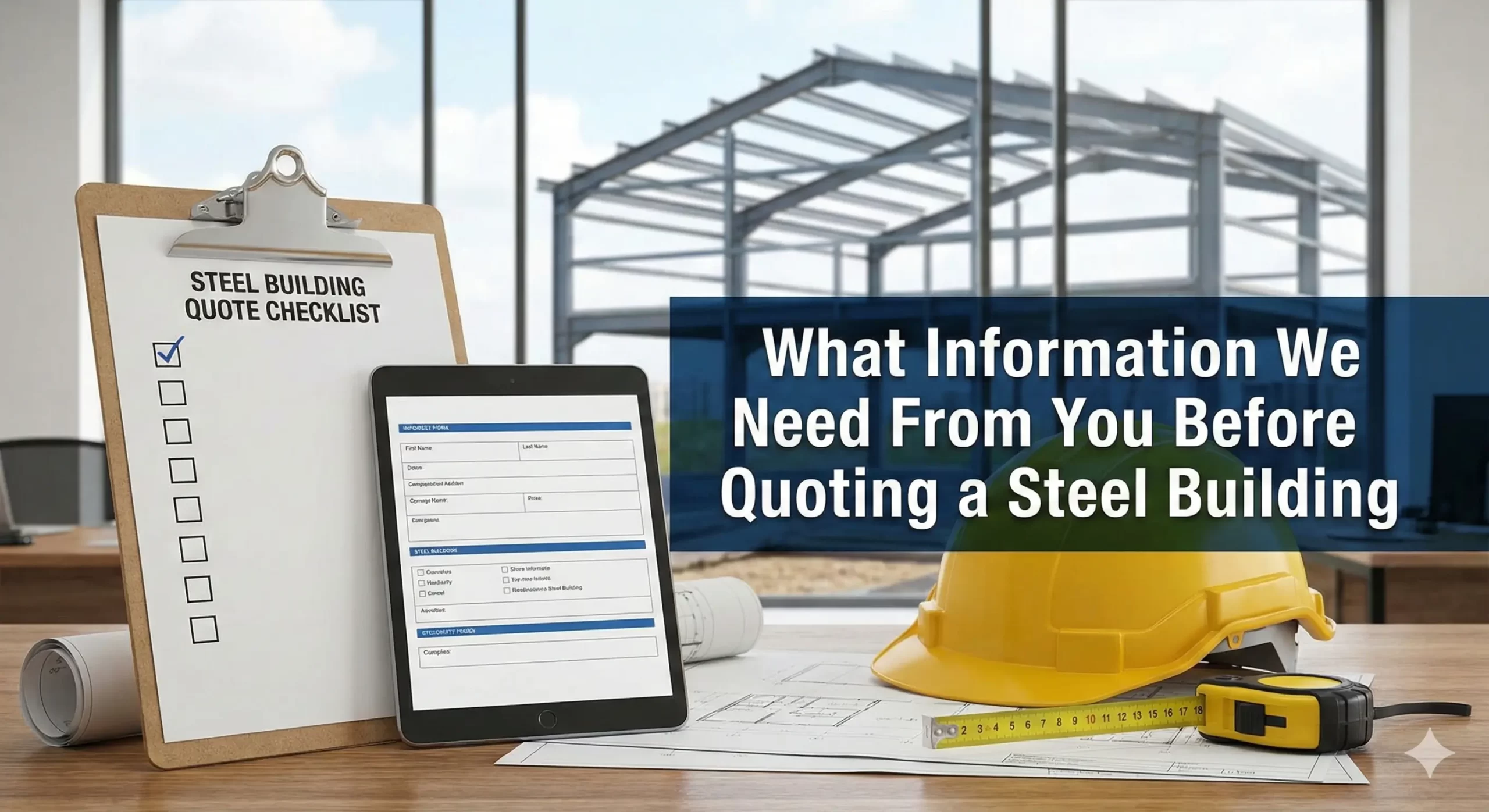
What Your Quote MUST Include: Never accept a one-page estimate with a single price at the bottom. Demand a detailed breakdown that lists:
- Design Loads: Wind (mph), Snow (psf), and Seismic ratings. If one quote has lower ratings than the others, it uses less steel and is effectively a weaker building.
- Steel Gauge: 26-gauge sheeting is standard. If a quote is suspiciously cheap, check if they swapped it for thinner, flimsy 29-gauge panels.
- Code Specifics: Does it include the current IBC (International Building Code) year for your area?
- Accessories: Are the walk doors, insulation, and gutters actually in the price, or are they listed as “optional”?
Red Flags to Watch For:
- “Estimate” vs. “Contract Price”: An estimate can change. A contract price is locked in.
- Missing Freight: Some low-ball quotes leave out shipping costs, which can add thousands later.
- “Clearance” High-Pressure Tactics: If a salesperson says, “I have a building left over from a cancelled order, but you have to sign today,” hang up. It is a common sales script, not a real discount.
Action Step: Take your three quotes and create a simple spreadsheet. List the weight of the steel for each building side-by-side. The price per pound of steel is often the truest measure of value.
Pro Tip #3 : Buy at the Right Time
Timing is everything. Most people wait until the first warm day of spring to order their building. That is exactly when prices peak because everyone else is doing the same thing.
To get the best price, you need to be a contrarian.
- Buy in the Winter (The “Off-Season”): December through March is typically the slowest time for construction. Manufacturers are often hungry for orders to keep their factories running. You can often negotiate better rates or faster production slots during these cold months.
- The “Lock and Hold” Strategy: This is a pro move. You can sign a contract and pay your deposit in January to lock in the current steel price, but schedule the delivery for April or May. You avoid the spring price hikes without having to store a massive steel kit in the snow.
- Watch for End-of-Quarter/Year Deals: Sales representatives have quotas. Approaching a vendor in the final week of a quarter (March, June, September, December) can give you leverage. They might be willing to shave off their commission or waive a fee just to close the deal before the deadline.
- Don’t Try to Time the Global Market: Steel is a commodity, like gold or oil. Prices change weekly based on global supply chains. If you see a price you can afford, lock it in. I have seen customers wait months hoping for a 5% drop, only to see prices spike 20% due to a new tariff or supply shortage.
Action Step: Ask your sales rep, “If I buy now but take delivery in 3 months, can I lock in today’s price?” If they say yes, you win.
Pro Tip #4 : Optimize Your Site Prep
Site preparation is often the biggest “unknown” in your budget. If you ignore it until the last minute, it can cost you thousands in delays and extra materials.
The golden rule of site prep is this: Dirt is cheap; concrete is expensive.
Here is how to prep your site without burying your budget:
- Get It Dead Level: This is the most critical step. If your ground slopes even a few inches, your concrete contractor has to fill that gap with expensive cement to make the floor level.
- Money Saver: Rent a skid steer or hire a local excavator to grade the site flat. Spending $500 on dirt work can save you $2,000 in concrete.
- Choose the Right Foundation:
- Monolithic Slab (Cheapest): For most workshops and garages, a “monolithic slab” is the most cost-effective option. This pours the footings and the floor all in one go. It requires less labor and less formwork.
- Piers or Stem Walls (Pricey): Avoid these unless your land is very uneven or local codes require them. They involve multiple pours and more complex labor.
- Plan for the Delivery Truck: Your steel kit will arrive on a massive 18-wheeler flatbed. If the driver cannot get to your site because of low hanging branches, a narrow driveway, or soft mud, they won’t deliver.
- The Cost: You might get hit with “demurrage” fees (waiting time) or have to pay a separate smaller truck to shuttle materials back and forth. Clear a wide, dry path before delivery day.
- What You Can DIY:
- Clear the Brush: You don’t need a pro to cut down small trees or remove rocks.
- Mark the Corners: Buy some stakes and string. accurately marking the four corners of your building helps excavators work faster (and charge you less).
Warning: Do not skip the “soil compaction” test. If you build on loose dirt, your slab will crack. Paying a few hundred dollars for a soil engineer to say “it’s good” is cheaper than fixing a broken foundation later.
Pro Tip #5 : Choose the Right Insulation & Energy Options
If you plan to heat or cool your building, insulation is not optional, it is an investment that pays you back every month. However, you do not need the same insulation for a tractor shed that you do for a home office.
Here is how to match the insulation to your needs (and budget):
- The “Condensation Killer” (Lowest Cost): If you just want to stop your roof from “sweating” and dripping water on your tools, use a Woven R-5 or Bubble Insulation.
- Cost: Very low.
- Best For: Equipment storage, sheds, and garages where temperature control isn’t a priority.
- Note: This offers almost no real thermal protection against freezing cold or extreme heat.
- The “Workshop Standard” (Best Value): For a shop you work in on weekends, go with Fiberglass Batt (3″ to 6″).
- Cost: Moderate ($0.50 – $1.50 per sq. ft.).
- Best For: Workshops and hobby garages.
- Pro Tip: Look for a system with a reinforced white backing (vinyl facing). It brightens up the interior of your shop so you need fewer lights.
- The “Climate Control” King (High Performance): If you are building a living space or a full-time office, Closed-Cell Spray Foam is the gold standard.
- Cost: High ($2.00+ per sq. ft.), but it seals every crack and adds structural rigidity.
- Best For: Barndominiums and commercial offices.
Smart Energy Upgrades with High ROI: Don’t waste money on “green” gadgets that take 20 years to pay off. Focus on these two quick wins:
- Insulated Overhead Doors: The biggest hole in your building is the garage door. Spending an extra $200 for an insulated door prevents massive heat loss.
- Translucent Panels (Skylights): Adding clear fiberglass panels to the upper walls (not the roof, where they might leak) provides free lighting during the day.
Pro Tip #6 : Consider a Standard or Pre-Engineered Kit
When buying a car, you don’t commission the factory to design a new chassis just for you. You pick a model off the lot because it is cheaper and faster. The same logic applies to steel buildings.
A “Pre-Engineered Metal Building” (PEMB) is a structure designed using standard templates. If you can make your project fit into one of these standard sizes, you will see a significant price drop.
- Stick to the “Sweet Spot” Sizes: Manufacturers have optimized certain dimensions to produce zero waste. If you order a 30×40, 40×60, or 60×100 building, you are using a design that has been built thousands of times. The engineering is effectively done, and the machines are already set up for it.
- Watch Your “Bay Spacing”: This is the distance between the main steel columns (the red iron frames).
- The Standard: Most factories are set up for 20-foot or 25-foot bays.
- The Mistake: If you ask for a 62-foot long building, the manufacturer has to create custom, odd-sized bays (like 20’ + 20’ + 22’). This requires custom cuts and more steel.
- The Fix: Change that 62-foot length to 60 feet. You just saved money on steel and engineering.
- The Benefit of Kits: A pre-engineered kit arrives pre-cut, pre-drilled, and pre-welded. You (or your crew) simply bolt it together. There is no welding on site. This drastically cuts down on expensive labor hours compared to traditional construction where materials are cut on the job site.
Pro Tip: Ask your dealer, “Do you have any ‘specials’ or ‘stock’ buildings ready to ship?” sometimes a customer cancels an order for a standard 40×60, and the factory will sell it at a discount just to clear the floor space.
Pro Tip #7 : Reduce Labor Costs
You have bought the steel. Now, who is going to build it?
Labor typically eats up 30% to 50% of your total project budget. If you are not careful, labor overruns can cost more than the building itself.
Here is how to keep installation costs under control:
- Skip the Middleman: Most people hire a General Contractor (GC) to handle everything. The GC then hires a steel erection crew and adds a 15% to 20% markup on top of their bill.
- The Fix: Be your own project manager. Hire the Steel Erector directly. You just saved yourself that 20% markup.
- Hire Specialists, Not Handymen: It might seem cheaper to hire a local carpenter, but steel is different from wood. A “Certified Steel Erector” knows exactly how the parts fit.
- Why it saves money: A specialized crew might charge more per hour, but they will finish the job in half the time. They won’t waste days staring at the blueprints trying to figure out where bolt “A” goes.
- Consider the “Hybrid” Approach (Partial DIY): You don’t have to build the whole thing yourself to save money.
- Hire Pros for the Frame: Let the professionals use the heavy cranes to stand the massive red-iron columns and rafters. This is the dangerous part.
- DIY the Sheeting: Once the frame is up, you and a few friends can screw on the wall panels and trim. It is tedious work, but it is safe and requires very little skill. This can shave thousands off the labor bill.
- Rent the Right Equipment: Don’t try to build a 16-foot tall building with ladders. It is slow and dangerous.
- The Investment: Renting a scissor lift or a telehandler (shooting boom forklift) costs money upfront, but it speeds up construction by 300%. The faster the crew works, the less you pay in labor hours.
Warning: If you decide to DIY, be honest about your skills. If you mess up the frame and have to call a pro to fix it later, it will cost double.
Pro Tip #8 : Look for Package Deals and Incentives
Sometimes the best price isn’t found by negotiating, but by finding a bundle that already exists. Manufacturers often package popular sizes with accessories to move inventory quickly.
Here is how to find the “hidden menu” deals:
- Ask About “Cancelled Orders”: This is a little-known secret in the industry. Sometimes a customer puts a deposit on a building but has to cancel due to financing or permit issues. The factory is left with a pre-made kit sitting on the floor.
- The Savings: Manufacturers will often sell these at a steep discount just to clear the space. Ask your sales rep specifically: “Do you have any cancelled or unclaimed kits in the 30×40 to 40×60 range?”
- Bundle Your Accessories: It is almost always cheaper to buy your overhead doors, walk doors, and insulation from the building manufacturer rather than sourcing them separately from a local hardware store.
- Why? When you buy a “turnkey” package, the manufacturer ships everything on one truck. You save on separate shipping fees, and you guarantee that the doors will fit the framed openings perfectly.
- Shipping Efficiencies: Freight is a killer. A dedicated truck can cost $3.00+ per mile.
- The Trick: Ask for a “split load.” If your building is small (under 1,500 sq. ft.), it won’t fill an entire flatbed. If you are willing to wait a few extra weeks, the factory can pair your delivery with another customer nearby. You split the shipping bill, potentially saving $1,000 or more.
- Financing Incentives: Some large manufacturers offer in-house financing or partnerships with lenders. These can sometimes come with perks like $0 down or deferred payments for 6 months. While this doesn’t lower the purchase price, it lowers your initial cash outlay, which is critical for cash flow.
Pro Tip: Look for “End of Quarter” clearances. Publicly traded steel companies often push aggressive discounts in March, June, September, and December to boost their quarterly sales figures.
Pro Tip #9 : Avoid the Most Common Buying Mistakes
You can follow every tip on this list and still lose money if you make a fatal error during the process. Some mistakes are just annoying, but others can bankrupt a project.
Here are the landmines to watch out for:
- Pouring Concrete Too Soon: This is the most painful mistake I see. A customer gets excited and pours the slab before the final engineering is done.
- The Problem: If your anchor bolts are even one inch off, the steel columns won’t fit.
- The Fix: Never pour concrete until you receive the “Certified Anchor Bolt Plan” from the manufacturer. Give this plan to your concrete contractor and tell them to follow it exactly.
- Ignoring Local Codes: You might find a cheap building online, but was it designed for your zip code?
- The Risk: If your town requires a 40 lb snow load rating and you buy a “clearance” building rated for 20 lb, the building inspector will fail it. You will be stuck with a pile of steel you are legally not allowed to build.
- The Fix: Call your local building department first. Ask for the current wind and snow load requirements. Give those numbers to your dealer.
- The “Height” Misunderstanding: When you order a “12-foot tall” building, that is the height of the eaves (the side walls).
- The Mistake: The overhead door opening cannot be the same height as the wall; it must be lower.
- The Fix: If you need to park a 12-foot tall RV, you need a building that is at least 14 feet tall. Always measure your tallest equipment and add 2 feet of clearance.
- Forgetting the Unloading Plan: The delivery truck driver is not responsible for unloading the steel. They just drive the truck.
- The Surprise: If the truck arrives and you don’t have a forklift on site, the driver can’t unload. You will be charged “waiting fees” by the hour while you scramble to rent equipment.
Final Checklist Before You Buy
You are almost ready. Before you sign that contract and wire your deposit, take ten minutes to go through this checklist. If you can check every box, your project is safe.
- Verify Local Codes: Did you confirm the exact Wind Speed and Snow Load requirements with your local building department?
- Check the Steel Gauge: Is the quote for 26-gauge sheeting (standard) or thinner 29-gauge?
- Confirm Door Clearances: Did you add 2 feet to the building height to ensure your overhead doors will fit?
- Read the “Inclusions”: Are the trim, screws, sealant, and anchor bolt plans definitely included?
- Plan the Off-Loading: Do you have a forklift rental arranged for delivery day?
- Verify Truck Access: Can a 70-foot tractor-trailer physically turn into your driveway?
- Lock the Price: Does the contract state the price is “locked” for a specific time frame?
- Check the Insulation: Did you include vapor barriers to stop condensation?
- Get it in Writing: If the salesman promised free shipping or a free door, is it written in the contract? (Verbal promises mean nothing).
- Review the Cancellation Policy: If you have to cancel, how much of your deposit do you get back?
Conclusion
Buying a steel building doesn’t have to break the bank.
By simplifying your design, timing the market, and managing site prep, you can save thousands without sacrificing quality. Remember, the goal is long-term value, not just the cheapest sticker price.
You now have the roadmap. Go get your quotes, negotiate with confidence, and build the structure you need at a price you can afford.
Ready to Build for Less?
Don’t let budget worries stop your project. At Metal Pro Buildings, we specialize in factory-direct kits that save you money on materials and labor.
Let our experts help you design the perfect building for your budget.
Get Your Free Factory-Direct Quote Now