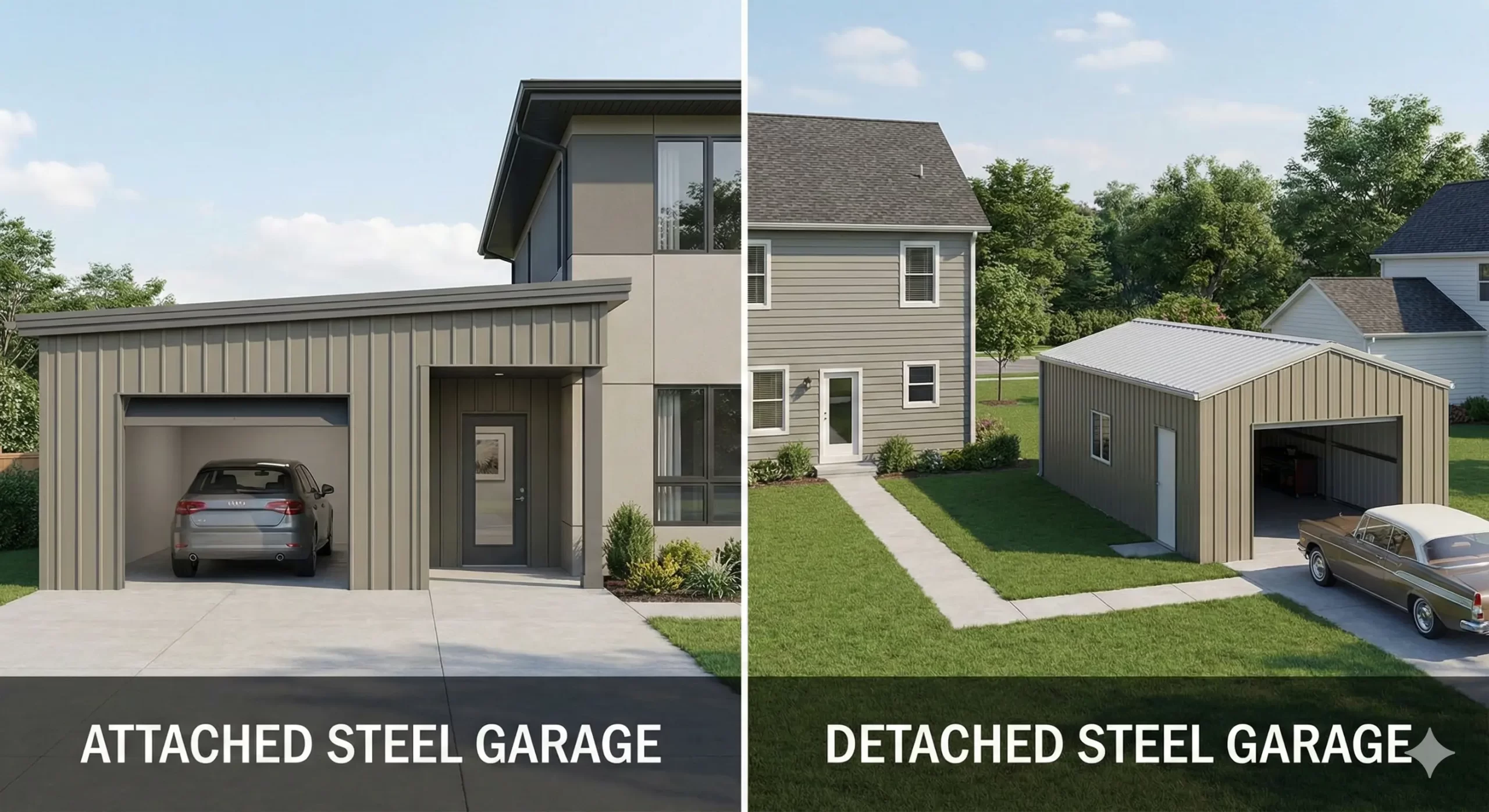

Ever wonder why some Canadian farms and workshops use those curved steel shells while others look more like modern commercial buildings? Many buyers reach this same crossroads: Quonset hut or straight wall steel building? The choice seems simple, but the wrong pick can cost you space, money, and months of frustration.
People often struggle with three things:
- Cost clarity : prices vary wildly across provinces.
- Space planning : curved walls change how you can use the interior.
- Weather performance : snow, wind, and deep-cold winters punish the wrong structure.
This guide solves those headaches.
You’ll learn how each building type works, what it costs in Canada, how they handle snow and cold, and which one fits your project goals. You’ll also get real insights from Canadian builders who install these structures every day.
Ready to compare them head-to-head?
Quonset vs. Straight Wall: Which Steel Building Actually Fits Your Project?
Choosing between a Quonset hut and a straight wall steel building can feel overwhelming. Both are strong. Both are durable. But they serve very different needs, especially in Canada’s harsh climate.
The core difference is simple:
- Quonset huts are curved, self-supporting steel arches.
- Straight wall buildings have vertical walls and a rigid steel frame.
Canadians search for this comparison because snow load, wind exposure, and rising material costs make the wrong choice expensive. Many buyers also want clarity on insulation, permits, and usable interior space.
Fast recommendations if you’re in a rush:
- Pick a Quonset hut for low cost, fast building, and tough snow resistance.
- Pick a straight wall building for full-height walls, clean interior layouts, and any project that needs finishing, insulation, or commercial-grade usability.
What Each Building Type Really Is (No Fluff)
What is a Quonset Hut

A Quonset hut is a prefabricated steel building with a half-cylindrical or arched shape. Its walls and roof are one continuous curved shell made from corrugated galvanized steel.
These buildings first became common during World War II, when their lightweight, ship-anywhere design proved ideal for military use and many remain in use today for storage, workshops, barns, or simple shelters.
One-sentence hook: Quonset huts give you quick, affordable, weather-resistant shelter with minimal labor and materials.
Want to dive deeper into what defines a Quonset with photos, build-options, and cost details? Check out our full guide: What Is a Quonset Hut — The Complete Guide .
What is a Straight Wall Steel Building

A straight wall steel building uses a rigid steel frame with vertical walls and a roof combining strength with a clean, box-like shape. Inside, you get full-height walls and a clear-span layout.
This design gives you flexibility. You can divide the space, build lofts, finish interiors, or insulate easily. For more on benefits, refer to this helpful guide: The Top Benefits of Constructing Straight Wall Metal Buildings
Straight-wall steel buildings offer full interior height, versatile layout, and easy customization for lasting projects.
Side-by-Side Comparison for Canadian Builders and Buyers
| Factor | Quonset Hut | Straight‑Wall Steel Building |
| Overall Cost (kit + foundation + labour) | Generally lower kit cost. Many Canadians pick Quonset for budget-sensitive builds. | Higher cost up front, but gives more long-term flexibility. |
| Usable Interior Space | Curved walls reduce usable wall space not ideal for full shelving or vertical storage. | Straight vertical walls maximize usable space perfect for shelving, mezzanines, or full-height storage. |
| Weather & Snow Load Performance (Canada-style climate) | Arch shape sheds snow and rain easily. Good for simple storage and barns, especially in snowy areas. | Built to meet Canadian snow/wind standards; engineered for heavy loads and harsh winter conditions. |
| Ease & Speed of Construction | Often prefab kits. Easier DIY-style, faster to erect, fewer interior supports. | Typically requires professional installation, more labour, and more complex foundation work. |
| Flexibility & Customization (insulation, interior finish, expansions) | Less flexible curved walls make insulation/finishing harder, and vertical partitions are awkward. | Highly flexible easy to insulate, finish interiors, install mezzanines, doors/windows, or expand. |
| Typical Use Cases (Canadian context) | Equipment sheds, barns, storage, simple workshops, cold-storage barns especially in rural or remote areas. | Garages, retail or commercial buildings, fully insulated workshops, industrial shops, warehouses, long-term projects. |
What This Comparison Means for Canadian Projects
- If you need affordable, quick, and weather-resistant storage or a basic farm shed, a Quonset hut often makes sense.
- If you want flexible, long-lasting space especially for workshops, garages, or insulated buildings a straight-wall steel building usually offers better value.
- In provinces with heavy snowfall or strong winters, the ability to engineer steel buildings to local snow/wind loads makes a strong case for straight-wall designs.
Quonset Huts: The Pros & Cons People Don’t Tell You
Pros
- Lowest price for a steel structure
Quonset huts usually cost less than straight-wall buildings because the arch design uses fewer structural components. Many Canadian suppliers highlight Quonset as the best low-budget option for storage and agriculture. - Easiest DIY build
Most kits arrive with pre-drilled, bolt-together arches. Many rural and northern buyers assemble them without heavy machinery or large crews, a major cost saver. - Excellent snow-load behaviour
Canada’s heavy winter snow works with a Quonset, not against it. The curved roof sheds snow naturally, reducing the chance of buildup. Builders often note that Quonsets “self-clean” after storms. - Very durable and low-maintenance
The simple all-steel shell has no roofing shingles, no trusses, and no vulnerable joints. Many last decades with minimal upkeep.
Cons
- Limited interior use
Curved walls reduce usable floor area, making shelving, machinery layout, or interior finishing harder. This is the most common regret among buyers. - Harder to insulate and finish
The arch shape complicates insulation installation, drywall, and vapor barriers. Many installers warn that finishing costs are often underestimated. - Fewer design and customization options
Doors, windows, and mezzanines are more restricted. Expanding later is also harder compared to rigid-frame buildings. - “Looks like a barn” aesthetic
Some homeowners or commercial buyers feel the rounded profile doesn’t fit residential or urban areas, which can influence permits in certain municipalities.
Straight-Wall Steel Buildings: The Pros & Cons That Matter
Pros
- Maximum usable interior space
Straight-wall buildings give full-height vertical walls. That makes them ideal for shelving, mezzanines, or dividing space into rooms. Great for workshops, garages, or warehouses. - Easy to insulate, finish, or convert
Because of flat walls and regular geometry, it’s simpler to install insulation, drywall, windows, and doors. Converting to heated workshop or living-space is much easier than with curved walls. - Versatile design and expansion-friendly
You can design straight-wall buildings to fit many uses: commercial, retail, storage, work-shop, even simple offices. Expanding later adding rooms, lofts, or partitions is usually simpler. - Better long-term usability and resale value
Because of flexibility, a finished straight-wall building tends to be more useful long-term. If you sell or repurpose the building (e.g. convert to business use), a straight-wall structure adapts more easily.
Cons
- Higher upfront cost
Materials and construction are more expensive than Quonset kits. Rigid frames, thicker steel, and more components add to cost both for kit and labour. - Longer build time, often requires professionals
Building a straight-wall steel building often means hiring contractors, potentially requiring cranes or heavy machinery. DIY is harder. - More complex foundation and engineering needs
To support rigid walls and possible mezzanines/lofts, foundation and framing work is usually more involved and costly. - Greater maintenance / heating costs (if poorly insulated)
If insulation or sealing is not done properly, a larger internal volume and flat walls can make heating (in cold Canadian winters) or moisture control more challenging.
Cost Breakdown in Canada
When you plan a steel building project in Canada, total cost depends on more than just the metal kit. These are the main components and what you need to expect.
Cost Components
- Base kit price : steel panels / structural framing
- Foundation / slab cost : concrete slab, footings or simple pad
- Labour / assembly costs : contractor or DIY time, machinery, transport
- Insulation, finishing, and utilities : for heated or usable space
- Long-term energy and maintenance : heating, sealing, insulation over years
Typical Price Ranges & What Affects Them
- Base kit (Quonset hut): For a modest- to medium-size arch hut (e.g. 20–30 ft wide, 30–50 ft long), expect lower costs than comparable straight-wall kits. That savings is often 20–40% vs straight-wall many buyers choose Quonset for that upfront value.
- Base kit (Straight-wall building): Costs more because of heavier framing, more steel, and complexity but gives more usable interior space and easier finishing.
- Foundation costs:
- Quonset huts sometimes sit on simpler slabs or even gravel pads reducing foundation cost.
- Straight-wall buildings usually need full concrete slab or perimeter footings. That means higher material and labour cost for foundation work.
- Labour and assembly:
- Quonset kits are often easier & quicker to assemble, sometimes DIY is possible, which cuts labour cost.
- Straight-wall buildings typically require contractors, possibly heavy machinery or cranes increasing labour and transport cost.
- Finishing, insulation & utilities:
- Curved walls of Quonsets make insulation and drywall more complex and costly per square foot.
- Straight-wall buildings simplify insulation and finishing work, but initial cost is already higher.
- Long-term energy & maintenance costs:
- If you plan heating or climate control (common in Canadian winters), straight-wall buildings tend to be easier to insulate efficiently.
- Poor insulation or shape inefficiencies (in curved walls) may lead to higher heating bills in Quonsets over the long run offsetting initial savings.
When the “Cheaper” Building Ends Up More Expensive
A building that seems cheaper up front (like a Quonset) can cost more over time if you:
- Add insulation, drywall, windows and heating.
- Need to modify the interior for storage shelving, lofts, or partitions.
- Face high heating costs because curved walls complicate insulation.
- Need to install concrete slab foundation anyway (for heavy equipment, winter use, or resale value) at a cost similar to straight-wall buildings.
What Buyers Should Ask Their Suppliers and Builders
Before buying any kit in Canada, ask:
- Does the quoted price include foundation, delivery, and installation?
- What are foundation requirements in your province (snow load, frost depth)?
- What will finishing, insulation, and heating cost?
- For insulated or usable buildings: what’s the estimated total cost (kit + build + finish + heating)?
Which Holds Up Better in Canadian Weather?
Snow Load Performance: Curved vs Rigid-Frame
- The curved roof of a Quonset hut naturally sheds snow and rain. Snow slides off more easily than on flat or low-slope roofs. That reduces buildup and lowers structural stress.
- A Straight‑wall steel building with rigid frame and pitched roof is often engineered to Canadian snow-load standards. This makes it very safe for heavy snow, provided design specs are followed.
- If located in a region with frequent heavy snowfall, both building styles can work but a Quonset may offer passive snow shedding, while a straight-wall building can offer stronger structural safety when engineered properly.
Wind Performance Prairies & Coastal Areas Included
- Quonset’s curved shape tends to deflect wind more cleanly, reducing wind-pressure points on flat walls or roof edges. That can make it resilient in windy areas.
- Straight-wall buildings rely on their rigid steel frame and proper anchoring to withstand wind loads. A well-built rigid-frame building can be extremely stable, sometimes more stable than a lighter Quonset, especially if built with quality steel and proper anchoring.
Insulation and Cold-Climate Behavior
- Quonset huts: curved walls and roof sometimes complicate the installation of insulation and vapor barriers. That can make sealing against harsh winter cold and condensation more difficult.
- Straight-wall buildings: with vertical walls and regular geometry, they are easier to insulate, finish, and seal. Heating and energy efficiency tend to be more manageable in a well-insulated straight-wall building, a key benefit in Canadian winters.
Moisture, Condensation, and Maintenance
- In a Quonset hut, curved surfaces and fewer joints reduce potential leak points. That simplicity helps resist moisture penetration and makes maintenance easier.
- In straight-wall buildings, because they’re often finished spaces with insulation, doors and windows, there is more need for proper sealing, moisture control, and good ventilation especially in cold climates.
What That Means for Canadians (Province, Climate & Use Depend)
- Snow-heavy regions (mountains, prairies, north): Both Quonset and straight-wall work. Quonset aids snow shedding; straight-wall’s engineered strength gives reassurance.
- Windy or coastal regions: Shape resistance of Quonset helps; straight-wall needs good anchoring and quality steel.
- Cold & insulated usages (workshops, garages, heated storage): Straight-wall is often more practical, easier insulation, finishing, heating control.
- Simple storage or barns requiring minimal insulation: Quonset often suffices, especially where quick setup and low maintenance are priorities.
Best Building Type for Your Project
Here’s a rough guide for which building type suits your project depending on what you want to do.
| Project / Use Case | Best Pick | Why It Works |
| Farm / agricultural storage (equipment, hay, tools) | Quonset hut | Low-cost, quick to build, naturally sheds snow/rain, and plenty of space for storage without finishing. |
| Residential hobby shop or small workshop | Quonset hut (if budget-sensitive and insulation not critical) or Straight‑wall steel building, if planning interior finishing or insulation | Quonset works for basic workshop/storage. Straight-wall is better if you want insulation, heating, comfortable working conditions, or a clean interior layout. |
| Commercial, retail or warehouse space | Straight-wall steel building | Full-height walls, easy to subdivide or finish, better suited for shelving, loading, or customer-ready space. |
| Industrial shops or heavy-duty workshops (machinery, fabrication, heavy loads) | Straight-wall steel building | Offers structural support, flat walls for equipment, easier to insulate/ventilate, expandable. |
| Public works, municipal buildings, garages | Straight-wall buildings or large Quonsets for simple storage | Straight-wall gives flexibility and compliance for finished spaces. Quonset can work for basic storage garages or sheds. |
| Remote northern builds or seasonal outposts | Quonset hut | Easier to ship, assemble, and maintain; sheds snow; works well if access to labor or heavy equipment is limited. |
How to Choose Based on Your Needs
- If your priority is low cost, simplicity, and robust storage, go for Quonset.
- If you aim to create a finished, insulated, usable building for work, commercial, or long-term use, straight-wall usually pays off.
- For heavy-duty, long-lasting, or multi-purpose buildings, straight-wall often gives the flexibility and strength you’ll appreciate later.
- For remote or rural areas with harsh weather and limited labor, Quonset can be the most practical.
What We See Across Canada
What We Recommend for Each Use Case
- For storage, agriculture, and remote builds → Quonset huts
Easy shipping, fast assembly, and excellent snow shedding make them ideal for farms and northern sites. - For workshops, garages, commercial spaces, and heated buildings → Straight-wall steel buildings
Flat walls simplify insulation, electrical work, and interior finishing essential for year-round use in Canadian climates. - For long-term or expandable projects → Straight-wall structures
They handle mezzanines, partitions, and future expansion far better than curved designs.
Common Buyer Mistakes We See
- Misjudging interior space in Quonsets
Curved walls limit shelving, machinery layout, and wall-mounted systems. - Underestimating insulation or finishing costs
Curved-wall insulation often surprises buyers with added complexity. - Choosing based only on the lowest kit price
Long-term costs (foundation, heating, finishing)change the real total. - Not checking municipal snow-load or permit requirements
Every province has its own standards; early checks prevent delays.
Provincial Patterns We’ve Observed
- Prairies (AB, SK, MB): Quonsets for storage; straight-wall for heated shops.
- Ontario & Quebec: Strong preference for straight-wall garages and workshops.
- Atlantic Canada: Quonsets for windy rural areas; rigid frames for finished interiors.
- Northern & Remote Regions: Quonsets dominate thanks to simple transport and rugged performance.
Quick Decision Guide: Quonset or Straight Wall?
If you want the fastest way to decide, use this checklist.
Your Checklist
Budget:
- Tight budget → Quonset
- Medium to higher budget → Straight-wall
Timeline:
- Need a fast, simple build → Quonset
- Okay with longer assembly or hiring contractors → Straight-wall
Interior Space:
- Mostly open storage → Quonset
- Need full wall height, shelving, or partitions → Straight-wall
Aesthetics:
- Rural, agricultural, or industrial look is fine → Quonset
- Want a modern, clean, garage-style look → Straight-wall
Heating or Insulation:
- Minimal or no heating → Quonset
- Year-round heating and insulation → Straight-wall
Permits & Codes:
- Simple storage use → Either
- Commercial, retail, or finished spaces → Straight-wall
Project Location:
- Remote or northern build → Quonset
- Urban, suburban, or business site → Straight-wall
Choose a Quonset if…
- You want the lowest cost possible
- The build site is remote or hard to access
- You only need cold storage or simple shelter
- Snow shedding is your biggest weather concern
- You prefer a fast, DIY-friendly assembly
Choose a Straight-Wall if…
- You want a garage, workshop, business space, or heated building
- Interior finishing matters (insulation, drywall, wiring)
- You need maximum usable floor & wall space
- You may expand later (mezzanine, rooms, extra bays)
- You want a clean, modern look suitable for residential or commercial use
Final Verdict + What to Do Next
Picking the right steel building is simple when you focus on how you’ll use it.
- Choose a Quonset hut if you need low-cost, fast, durable storage with minimal finishing.
- Choose a straight-wall steel building if you want full wall height, easy insulation, and a clean interior for year-round use.
Both styles are strong. Both work in Canadian weather. But only one will fit your long-term plans so match the building to the job, not the price tag.
Ready to Plan Your Steel Building?
Metal Pro Buildings can help you compare options, estimate costs, and get engineered drawings for your province.
Request a free quote or project consultation today and let our team guide you to the right steel building for your needs.